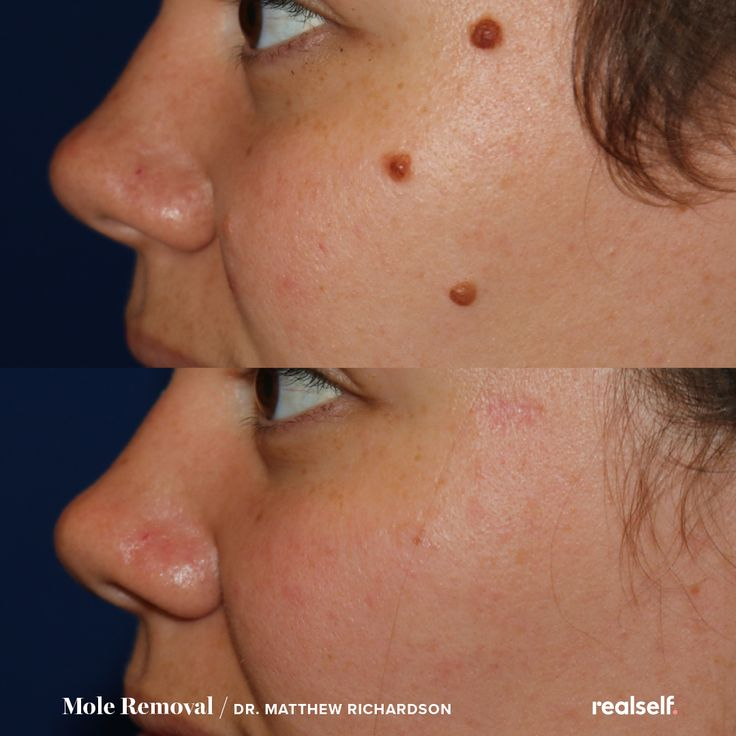
What is Mole Removal & Why It’s Effective?
Mole removal at Dermacian uses advanced radiofrequency and laser techniques to precisely remove moles with minimal damage to surrounding tissue. Each mole is first assessed by a dermatologist to determine the best removal method and whether histopathological examination is needed.
Our approach ensures that moles are removed cleanly with excellent cosmetic outcomes. We prioritize both safety and aesthetics — every mole is examined for signs of atypia before removal, and suspicious moles are sent for laboratory analysis to rule out melanoma.
Types of Moles We Remove
Moles (nevi) come in various forms, and our treatment approach is tailored to each type:
- Raised moles (dermal nevi) — fleshy, raised bumps that may catch on clothing or jewelry
- Flat moles (junctional nevi) — pigmented flat spots on the skin surface
- Hairy moles — moles with hair growing from them, often raised
- Atypical moles (dysplastic nevi) — moles with irregular shape or color that need evaluation
- Congenital moles — moles present since birth, ranging from small to large
- Acquired moles — moles that develop during childhood or adulthood
Mole Removal Techniques at Dermacian
We use multiple techniques depending on the mole type, size, and location:
| Technique | Best For | Downtime | Scarring |
|---|---|---|---|
| Radiofrequency Ablation | Raised moles, skin tags | 7–10 days | Minimal |
| Laser Removal (CO2) | Flat moles, facial moles | 5–7 days | Very minimal |
| Surgical Excision | Large or suspicious moles | 10–14 days | Small linear scar |
| Punch Excision | Small to medium moles | 7–10 days | Minimal |
| Shave Excision | Raised moles at skin level | 5–7 days | Minimal |
The ABCDE Rule: When to Be Concerned
Before any cosmetic removal, our dermatologists assess every mole using the ABCDE rule:
- A — Asymmetry: One half doesn’t match the other
- B — Border: Irregular, notched, or blurred edges
- C — Color: Uneven color, multiple shades of brown/black
- D — Diameter: Larger than 6mm (pencil eraser)
- E — Evolving: Changing in size, shape, color, or elevation
If any of these signs are present, we recommend biopsy/histopathological examination.
Is Mole Removal Right for You?
Mole removal may be right for you if you have:
- Moles that are cosmetically concerning or affect your appearance
- Moles that catch on clothing, get irritated, or bleed
- Changing moles that need evaluation (ABCDE rule)
- Raised moles that affect shaving or grooming
- Moles on visible areas (face, neck) that you want removed
- Multiple moles and want a full skin check
Recovery & Aftercare
Recovery depends on the removal technique used:
- RF/Laser: A small scab forms, falls off in 7–10 days. Keep the area clean and protected from sun.
- Excision: Sutures are removed in 7–10 days. A small scar fades over 6–12 months.
- Sun protection is critical — apply SPF 30+ to the treated area for at least 3 months to prevent pigmentation.
- Avoid picking at scabs — let them fall off naturally for best cosmetic results.
Key Benefits
The Procedure at Dermacian
Dermoscopy Exam
Mole is examined with dermoscopy to rule out malignancy.
Local Anesthesia
Area around the mole is numbed for a painless procedure.
Excision / RF Removal
Mole is removed by shave excision, punch biopsy, or radiofrequency.
Wound Care
Dressing and healing instructions provided; biopsy sent if needed.
Why Choose Dermacian Jaipur?

Doctor's Note
"We always examine moles before removal. If a mole looks suspicious, we send it for histopathology to ensure your safety."
— Dr. Vivek Rungta, Dermatologist & Hair Transplant Specialist